(ed.– This is the first of many issues I intend to OCR/transcribe now that I have software that actually does the job! I’ll do the ones I already have posted, then start scanning in the ones I don’t. I’ll be figuring out a way to properly present all this at some point. Time to get this back off the ground.)
>> Original Post with full images and commentary are here <<
Table of Contents
YOUTH’S COMPANION
Published Weekly, by NATHANIEL WILLIS, at the Office of the Boston Recorder, No. 11, Cornhill. — Price, $1,00 a year in advance; or $1.25 if not paid in advance.
No. 10 — BOSTON, July 20, 1838. — Vol. XII.
I’VE LOST MY WAY.
FROM THE FRENCH.
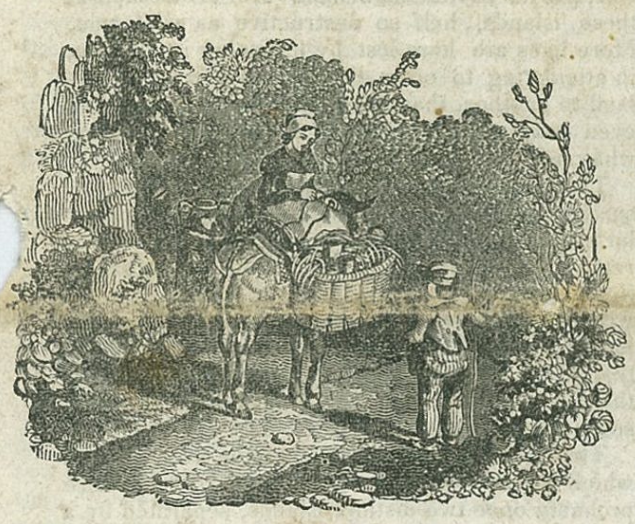
Little Antoine was a very obliging little boy, and in this respect quite unlike his elder brother, Julian, who was too selfish to do any person a favor. One fine warm day in August, the two boys wandered forth into the fields. They had not proceeded far before they saw a poor young woman, by the road-side, who had met with an accident and needed their assistance. She was going to market with a donkey, who was heavily laden with two panniers, when the strap which bound them broke, and a parcel of fine fruit and vegetables rolled forth from them upon the ground.
On seeing the accident, Julian and Antoine ran quickly to the spot, but with quite different motives. The younger, brother was thinking only of the assistance which he could render the poor young woman, but Julian was thinking what a good chance it would be to have a fine feast of fruit. When they came up to the spot, Antoine set about assisting the woman to pick up the fruit and other things, and replace them in the panniers. But Julian, after selecting some of the finest peaches and grapes, sat down on a stone to devour them, without offering to be of any assistance. Sue even laughed at the accident, and wasted the grapes by throwing them about, or giving them to the donkey.
The young woman was sadly afflicted by the accident, as she was quite poor, and had hoped to get a good price for her articles. At last, with Antoine’s good help, she succeeded in again arranging her panniers, and then went on her way. First, however, she gave Antoine the finest nectarine that she could find, although he did not wish to take it, since his brother had relieved her of some of the best of her store.
A few days after this adventure, the two boys wandered into the country to such a distance, that they both lost their way, and knew not what path to take, by which to return home. Antoine became quite tired, and could not keep up with Julian, who ran very fast. In fact, he ran quite away from his younger brother, and thus they were separated, as well as lost. Well: Julian proceeded on, till it was quite dark, and then he began to grow frightened. He saw several persons, whom he knew, but he was ashamed to ask their aid, for he had often treated them badly, or refused to render them some slight service. At last, when the night was advanced, he came to a small hut, which he resolved to enter. He was tired, hungry, and frightened, and he could walk no farther.
He knocked at the door. It was opened by an old woman, who, on learning his errand, bade him come in, It was quite dark in her little room, but she said that she would light a candle in a moment, and fix some clean straw for him to lie on. When she had lighted€,the candle, Julian regarded her more attentively. What was his dismay to find that she was an old beggar woman, at whom he had thrown stones the day before! He tried to conceal his face, but she immediately recognised him; and said: — ‘‘You see that there is no object so mean, which may not one day be of aid to you. Well, it is hereafter. You stoned me yesterday, but I will give you lodging to-night. Food have I none. And may Heaven forgive you as readily as I do.”
Julian’s feelings were not the most enviable at that moment. He blushed deeply, and felt the acutest remorse. However, he was obliged to take up with the old woman’s hospitality, and falling on his knees, he expressed his sorrow for his wicked conduct towards her the day before.
What became of little Antoine all this time? Before night-fall, the very young woman whom he had assisted a few days before, passed by the spot where he stood. She was returning home on her donkey, and on seeing Antoine, she inquired of him what was the matter. ‘‘I’ve lost my way,” was the reply. ‘‘Come, then, you shall go home with me,” said she; and dismounting from the donkey, she permitted Antoine to ride in her place. They soon arrived at a neat little cottage, where a plentiful supper was soon provided for them. He staid there all night, and in the morning after breakfast, a neighbor took him in a wagon to his father’s house. Julian had to return home on foot, and he was almost starved, when he arrived. But, I am glad to say, that this adventure taught him to-treat no one with scorn, but to render every obligation in his power, to those who stood in need of his assistance. — Child’ Annual.
NARRATIVE
PARTIALITY
[Concluded from our last.]
(ed.— I do not have the previous edition yet, I will fill in / link when I do.)
Miss Stewart did not dislike Annie Lewis, but she expected from the child more than she was able to perform; while the aptness of Sarah in acquiring her lessons, made the others appear more deficient. Had she but considered that ‘‘all have not the same gifts,” and been content with hearing the little girl repeat three lines of the Catechism, instead of three pages, which was sometimes the length of the lesson, Annie might, in time, have stored the whole in her memory. But Miss Stewart wanted patience. She could not sit still and listen to the stammering tone of an imperfect reader, or the hesitating voice, which tried to repeat the verses of a hymn. The book in such cases was usually soon abandoned with the exclamation, ‘‘Dear me! Susan, you don’t know this lesson at all, pray learn it again, if you have forgotten it;” or, “There, Maria, that will do; you read so badly to-day, I can’t bear to hear you any longer.” With Sarah Green, however, these faults did not exist; she could read fluently, and repeat correctly; for her father, though a laboring man, was not a poor one, and during the week, his daughter reaped the benefit of good instruction. No wonder, then, that study was easy to her. But to those who were deprived of this advantage, how important was that they received in the Sunday School! How many parents looked to it, as the only education their children were to receive, and valued it the more, in proportion to its limitation. Miss Stewart had soon acceded to the request of Sarah, that she would come and see her, particularly as her mother was sick. She found Mrs. Green in a neat house, and if not the luxuries, at least with the necessaries and comforts of life about her; a physician to attend, and a kind mother to wait upon on her. But Sarah’s teacher was received with so much gratitude and respect, that she was quite charmed with her visit, and called again and again to inquire after the invalid; while she was profuse in her presents of tea, loaf sugar, chocolate, &c. all of which Mrs. Green could herself have purchased, had she needed them.
Our friend Annie, too, had made the same request: ‘‘Mother was sick, and would be so glad to see her!” Miss Stewart readily promised; but there was nothing very attractive in Annie, and she was soon forgotten. Weeks went by, and the little girl again ventured to the favor of ‘‘just one call to see poor mother;”’ and again the promise was made only to be broken. “Will you come this week, ma’am?”’ said the child, “mother’s cough is so bad!”
“I don’t know, Annie, perhaps I will; but where did you tell me you lived?” “I have forgotten,” said Miss Stewart, tying the strings of her bonnet as she spoke.
“No. 53, ma’am, up stairs, in the front garret,”
“Bless me! so high up?” said Miss Stewart. ‘Well, I’ll see about it, Annie,” and the little creature departed, full of joy even with this vague and uncertain answer, so bright are the hopes of childhood, even when dimmed by the shadows of premature care.
The question will naturally arise, Was Miss Stewart fitted for the responsible office she had taken upon herself? And we boldly answer, that she was not: she possessed not the meek and patient spirit of Him, whose word she had undertaken to teach; she needed more of the self-denial of her heavenly Master, and without these virtues, she was undoubtedly wanting in the chief requisites of a faithful Sunday School teacher. And yet Emily Stewart was not without some estimable qualities, both of head and heart. Convince her that she was wrong, and her first wish would be, to alter her course of conduct; or, awaken her sympathies, and her generosity knew no bounds. But she was too easily charmed with a pleasing exterior, and in the case of her pupils, she selected the most promising, who immediately became her favorite.. She could not love them all alike; and many a little heart beat with a feeling of envy, when their teacher commended Sarah’s well recited chapter; or declared, as she often did in their hearing, that she was the smartest girl in the class.
True to her promise, the benevolent Miss Wilmot found her way up to Mrs, Lewis, and listened with interest and attention, to the widow’s story of poverty and sorrow. It was no new tale; others had suffered as she had done, some, perhaps, more so. But the kind heart of the Christian was touched at the simple manner of its recital, and a tear, such as had often flowed before at the bedside of the afflicted, and which now dimmed the soft eye of Ellen Wilmot, spoke more comfort to the bosom of Mary Lewis than she had known for years. She felt as if God had answered her prayers, and that she might lie down and die in peace, with no care for Annie on her mind; confident that she would find a friend in her gentle auditor. There was no ostentatious display of benevolence in Miss Wilmot. She quietly conversed with the widow on her hopes of another world, and her difficulties in this, and when she rose to go, a single shilling was laid upon the table, with the words, “It is very little, Mrs. Lewis, but God has withheld from me the power of bestowing much;” and with a promise to come again before Sunday, the young lady departed. To Mary Lewis, however, it appeared like the visit of an angel, and she could only pray for a blessing on that warm heart, and thank God for giving her to see the light of that happy day.
Bessie Bloomfield and her mother embraced the first opportunity of informing Miss Wilmot that Annie’s teacher had never been to see her. “Are you quite sure that such is the case?” said Miss Wilmot. “Mary Lewis did not mention it to me. I think you must be mistaken?”
“Oh! no, ma’am,” cried mother and daughter in a breath, “it is quite true.”
“But Miss Stewart visits her scholars, and I should not think she would forget Annie.”
“Ah! yes, ma’am, she visits them she likes; she goes to see her favorite, Sarah Green, but she does not care for poor folks.”
“Hush, hush, Bessie,” said her friend, “you wrong Miss Stewart; but I will ask her myself, and if she has not been, will persuade her to go.”
The next Sunday, accordingly, as soon as the school was dismissed, she joined Miss Stewart, and after a few general inquiries, asked if she knew that poor Mrs. Lewis was extremely ill.
“What, Annie’s mother? No, I did not. I have heard she was complaining, but I did not think it was any thing serious.”
“Have you seen her lately?” said Miss Wilmot.
“*No. I—I have never called there. I intended it, but have been prevented; however, I will go soon.”
“The poor woman is in very destitute circumstances,” said Miss Wilmot, but I believe the pains of earth will be of short duration to her. She is sinking so rapidly, that I think a few more days, or at most weeks will end them.”
“I will go this week without fail,” said Miss Stewart, and her conscience reproached her painfully, as she returned to her scholars. Annie was not at school, and she resolved that on the following day she would endeavor to fulfil her long neglected duty to the poor child. Monday morning came, but brought with it a heavy rain, which precluded the possibility of going out. Tuesday was no better, and it was not until Wednesday that Miss Stewart set off in search of Mary Lewis. She reached at last the narrow street, and entered the miserable building. With fear and fatigue she climbed stair after stair, and knocked faintly at the door of the front garret described by Annie. A low murmuring of voices sounded from within, and the door was opened by Bessie Bloomfield, whose eyes were red with weeping. Miss Stewart stepped softly into the apartment, and beheld Miss Wilmot kneeling in prayer at the bedside, while Mrs. Bloomfield held the sobbing Annie in her arms, endeavoring to soothe her. Mary Lewis was almost gone, nor did she unclose her eyes as Miss Stewart drew near the bed, but she held Miss Wilmot’s hand in hers, and said faintly, “My child, you will then take care of her?”
“I will, indeed, the Lord assisting me,” said Miss Wilmot, solemnly; “never, while I live, shall she want a friend.”
“May God bless you,” said the widow. “Annie,” she called, attempting to raise herself, and the child was at her side in an instant, “Annie, Miss Wilmot will soon be your only friend; you must love her, and obey her as you would me. She will try and get you into her class; and tell your teacher I—” but the sentence died on her lip. She fell back suddenly on her pillow, and with one long sigh exchanged earth for heaven. There was silence for an instant, when all was over; but it was broken by the piercing shrieks of the little orphan, which now rang through the apartment as if they might have recalled that sleeping mother to life and consciousness, and throwing herself upon the body, she screamed in agony.
Margaret and Bessie pressed forward and raised her from the bed, while Miss Wilmot, taking her from them, strove to utter some word of comfort; and Emily Stewart, who, though thoughtless, was not unfeeling, added her tears to those of the weeping child, as they fell in showers upon the hand of her guardian. “Your mother is in heaven, Annie,” said Miss Wilmot, “with her Saviour and his angels. Would you call her back again from so much happiness to sickness and sorrow?”
“Oh! yes, yes,” cried the inconsolable Annie, and springing from the arms that supported her, she sprang again to the bedside screaming, “Oh, mother, mother, speak to me once more, just once more, mother!”
But we write not to excite the feelings, but to draw a moral from our story, and must therefore throw a veil over grief, too deep for utterance or description. As Miss Stewart looked round that miserable room, destitute of every comfort, and gazed upon the lifeless form of Mary Lewis, how did her heart condemn her! How bitterly did she acknowledge, that she might have done much, very much, that would have alleviated the sufferings of that now silent clay, while the tears and moans of Annie added to her remorse. What could she say to comfort her? Another filled the place that should have been hers, but she felt it was right it should be so; and as she weighed her own conduct with that of her fellow-teacher, the character of Ellen Wilmot, her inferior in wealth and station, rose higher and higher in the balance, and shone with a lustre, the Christian graces alone can give. While these thoughts were passing through her mind, Margaret Bloomfield and her daughter were preparing the body for the grave; and Miss Wilmot had taken her young protege into an adjoining room, the door of which stood open, it being unoccupied, and thither Emily followed them.
“Oh! Miss Stewart,” cried Annie, as she perceived her teacher, “if you had only come when I first asked you, may be she would not have died.”
“Do not reproach me, Annie,” replied Miss Stewart, her lip trembling as she spoke, “for I feel how negligent of my duty I have been. You will soon go into Miss Wilmot’s class, and then you will be better off than you were with me. I know I have often spoken cross to you, Annie, and thought you tiresome, Will you forgive me?”
But the little girl appeared not to hear the question, for she continued to sob on Miss Wilmot’s lap, without a reply; and Miss Stewart finding she could be of no use, begged that she might be permitted to defray all the expenses of the funeral, and departed.
Miss Wilmot not being able to take upon herself the entire maintenance of the orphan Annie, she was confided for a few weeks to the kind care of Margaret Bloomfield, and the warm affection of the goodhearted Bessie; after which, she was removed to the comforts and advantages of the Orphan Asylum.
Emily Stewart never forgot the lesson she received at the death bed of Mary Lewis. From that day she set about reforming her conduct as a Sunday School teacher. She endeavored to view the characters and abilities of her scholars through a proper medium; gave up by degrees her foolish predilection for Sarah Green, and overcame at last, an evil which should never exist in a Sunday school—the evil of Partiality.
M.N.M.
DESCRIPTIVE.
LETTERS FROM SANDWICH ISLANDS.—No. 5.
Wailuku, Maui, November 8, 1837.
TO THE READERS OF THE YOUTH’S COMPANION
Dear Friends,—Though the people of these islands are rapidly decreasing, yet there are I think fewer casualties occurring here than in most countries. The elements seem to me to be unusually peaceful at the Sandwich Islands. After residing here about nine years, I can truly say, that during an equally long period of my life spent in the United States, I have never seen so little of the terrific caused by the raging of the elements. Such deafening and long continued thundering, such vivid lightning as I have heard and seen at home, has not been known here since my arrival. Indeed thunder and lightning are not common here. Nor do we experience such winds, which in the United States and in other places, prostrate forests, and the habitations of men. Nor are freshets at these islands, half so destructive as with you. More lives are here lost by drowning in the sea, in attempting to cross the channels from one island to another, than in any other way. And less even here, than you might suppose, considering what risk the people often run.
The elements, I said, seemed to me to be unusually peaceful. Yet sometimes they are singularly terrific and destructive. Such is the case in regard to their volcanoes, and earthquakes. Some remarkable phenomena are also connected with the movements of the ocean, which washes their shores. One of these occurred last night at this place. I have just returned from witnessing the scene of desolation, and I hasten to give some account of it.
The station of Wailuku is on the neck of land which unites east and west Maui. These were probably once two distinct islands, separated by a channel 5 or 6 miles wide. The land which I suppose was once covered with water is merely a sandy strip of land, producing nothing but coarse grass. To the south east of us 6 or 7 miles, there is a considerable of a bay, and along the shore there are quite a number of people who live principally by making salt. A large quantity is annually made here of a good quality, which finds a ready market. Nearly east of us is another bay, distant about two miles. On this shore, there was yesterday at the going down of the sun, a village consisting of twenty seven houses, and probably between seventy and one hundred souls, who subsisted principally by fishing. This morning only a single house remained. The account of this destruction as I gather it from individuals present, is as follows.
About 8 o’clock last evening the sea suddenly receded. It was instantly perceived, and there being a moon, the children ran to gather up the fish which were thus left on dry ground. The sea soon returned with great violence. The first wave dashed over the whole settlement, sweeping before it many of the smaller and poorer kind of houses, and warning all the inhabitants of the utter insecurity of their situation. The sea washed the land to the extent of nearly one fourth of a mile, beyond high water mark. It receded, and again dashed over the devoted village. his second wave, which, judging from the appearance this morning, was nearly as powerful as the first, must have completed the work of destruction; for though there were three others, yet they were comparatively feeble. The houses were of native material, posts driven into the ground, and thatched with grass and the leaf of a certain tree, much used in some parts of the islands. They were all within five or six rods of the sea, and not more than four or five feet above its level. These houses were quite too frail to sustain such a shock. They were prostrated to the earth, and most of them carried one fourth of a mile and left in a large fish pond. Every thing that the poor people had was destroyed or greatly injured. True, they had not much, were very poor; but the poor man is no less a sufferer than the rich, when all is swept from him. Many canoes which are valuable, were destroyed by the crashing of the houses, fish nets of which there were a good many, were greatly injured, callabashes, mats, and sleeping kapa, fowls, &c. were lost. Yet in all this confusion, the children, of whom there were quite a number and some of them small, were all saved. God was gracious, and enabled all excepting two individuals to escape. Two aged women, one of the whom was sick and feeble were drowned.
Such are the facts in regard to the destruction of Kaholui, a village of fishermen on East Maui. I am unable to account for this action of the sea. Had there been an earthquake, the cause would have been obvious; but no one that I have seen pretends to have felt a shock at that time, nor have I felt a shock for more than three years. Several of the people say that in the lifetime of Tamehameha, their former king, something of the kind occurred, but much less violent. Some are already predicting the death of the king! Alas, poor people, would that they would lay to,heart the admonition which God in his holy providence is now giving them, and hasten to the Rock of ages, that when their island and all they have shall be swept away, they may be safely moored in the haven of eternal rest.
From your affectionate friend, J. S. Greene.
PARENTAL.
CONVERSION OF CHILDREN.
A simple illustration of faith, which a child will easily understand, is given by Mr. Abbot, in his “Corner Stone.”
A father was once amusing a number of children with an electric machine; and after one or two had touched the knob, and received the shock, they drew back from the apparatus, and looked upon it with evident dread, The father presently held out to them the jar, uncharged, and consequently harmless, and said distinctly, but without emphasis, “If you touch it now, you will feel nothing. Who will try?” The children drew back with their hands behind them
“You do not believe me.”
“Yes, sir,” said they with one voice; and several hands were held out to prove their faith; but they were quickly withdrawn, before reaching the dangerous knob. One alone, a timid little girl, had that kind of confidence in her father, which led her really to trust him. The rest believed his word, but had not heart-felt faith in it. Even the little believer’s faith was not unwavering. You could see on her face, when the little knuckle approached the harmless brass ball, a slight expression of anxiety, showing that she had some doubts and fears after all; and there was an evident feeling of relief, when she touched the knob, and found, from actual trial, that her father’s word was true, and that there was really nothing there.
Having thus given the child an idea of what faith is, even although it be towards a father, a foundation is laid to show him what faith is towards God. Faith towards a father is confidence in that father—in his veracity, kindness, &c. Faith in God, is confidence in his truth, mercy, benevolence, wisdom, &c.
Children are often told that they should love the Lord Jesus Christ; but I have sometimes found a difficulty in a child’s mind, how it can love an object so distant, as it imagines Jesus Christ to be. Christ is represented as in heaven—he has never seen him; and being so far off, the little heart finds it difficult to love an object under such circumstances. A case of this kind recently came under my observation. I sat down, and talked after this manner:—
“Now, C——, suppose your father was at Boston; you could not see him—but could you not think of him?—could you not think of him as your maker?—and could you not love him just as affectionately as if he were here present?”
“Yes, I could.”
“Well, then, it is not necessary to see a person, in order to love him?”
“No.”
Suppose, then, that you should hear of some good person, whom you yet never saw, and whom you may never see; yet, you have heard of him—of his kindness, his excellence, his benevolence, and other good traits of character; now, could you not love such a person?”
“Yes.”
“Why, then, cannot you love the Lord Jesus Christ? You do not see him—but you can think of him—how good and glorious he is—the chief among ten thousands, and the one altogether lovely. You do not need to see your father in order to love him, and now you perceive you do not need to see Jesus Christ in order to love him.”
To this she assented. It was all quite plain that how distant soever Christ seemed to be from her, it was as easy to love him as if he were present.
Children are often exhorted in another form to love Christ—i.e. to give their hearts to him. In many cases, they know not what is meant by this language, nor what they must do. A short time since I found a child, who had been anxious some days, and was still weeping over her sins. Among other things, I told her she must give her heart to Christ; but upon inquiring whether she understood what was meant by this language, she hesitated. I then addressed her as follows:—
“Suppose you had something in this room, which you valued greatly—more than, any thing else in the whole world; and suppose the Lord Jesus Christ should come to you, and say, “I want you to give me that. I know that you love it—you love it better than any thing else, and better than all other things—but I want you to give it to me.” Now, M——, what would you do? would you give it to him?”
The tears flowed faster still; and while her little heart seemed to be almost bursting, and, from the excess of her feelings, she could scarcely articulate, she replied, “Yes, I would give it to him.”
“Would you give it to him freely—at once—now?”
“Yes, I would.”
“Well, M——,” said I, “you love yourself better than any thing else—and better than all things in the wide world—and now Christ wants you to give yourself to him—he wants your heart. He says, Give me thine heart; he wants its love, its confidence, &c. Now, will you give yourself to him?—will you give your yourself now?”
“I will,” she said—”I do.”
MORALITY.
THE TWO HOUSES.
i once knew a rich man who determined to have a very large and beautiful house built for himself. He bought a lot of ground in a beautiful part of the city, and took great pains to have the house built in the best manner, There were many spacious rooms and wide halls. It was planned so as to be warm in winter, and cool in summer. No expense was spared to have it as comfortable and complete a dwelling as could be made. No doubt, he looked forward to many years of enjoyment in his new and elegant house.
At the same time that this large house was preparing for himself and his family, he had another built for them. And there was a great difference between the two. For the second house had but one small room for the whole family, and that room was mostly under ground. It had, indeed, strong walls and was built of marble, but it had no windows and but one small door; and that was made of iron. If you should see the two houses, you would exclaim, what a contrast there is between the wide and lofty mansion, so bright and handsome, and the low building under the willow tree, which one would scarcely notice! Yes: these two houses were built for the same people. The one was for the living family; the other for the dead. For the low house under the tree is the vault into which their bodies are to be placed, as one alter another shall be called away from life.
The vault was soon finished, and it was ready long before the large house. And into which of them do you think the rich owner himself went first to take up his abode? Strange as it may seem, he was ready for the vault before the fine dwelling was ready for him; and many months before the spacious rooms of the new house were fit to be inhabited, its builder was laid in the narrow, dark, and cold apartment, which he will not leave until the earth shall give up its dead at the last day.
This is a fact which ought to fix the attention of the young, To you every thing in life seems bright and happy, and promising great enjoyment, and you forget its end, or imagine it is too far off to be thought of. The house of the living is so large and beautiful, that it hides from your sight the house of the dead. But remember that, like the man I have been telling you of, you may have to lie down in the grave before you have entered upon the pleasures of life which you are expecting. If you will be wise, you will live and act in such a manner as to be prepared both for life and death; to enjoy the one, and not to fear the other. The Saviour has declared: “Whosoever liveth and believeth in me shall never die.” This is true in the most important sense possible. The true believer, whose sins are pardoned, and who is accepted in Christ, has the promise of a house which is not made with hands, but is eternal; not in this perishing world, but in the heavens; and the passage from this life to that is not to die as the world speaks of death; it is to fall asleep on earth, and awake with God. —Youth’s Friend.
SABBATH SCHOOL.
Written for the Youth’s Companion.
LETTERS FROM A TEACHER, TO THE CHILDREN WHO ATTEND THE SABBATH SCHOOL AT S.
Boston, April 25, 1838.
My Dear Young Friends,—In my last I promised to tell you what I could recollect about the Sabbath School in the State Prisons at Philadelphia and Baltimore.
At Philadelphia, I talked to the prisoners without seeing them. It seemed very odd. I stood at one end of a long passage, from which little doors opened into the cells of the prisoners. The building is so contrived that a voice in that passage can be heard by a great many of the convicts. As I did not speak with the prisoners, I cannot tell you much about them. Each is kept constantly alone. Those who have examined this subject most carefully, do not like this plan.
I think it was at the Philadelphia prison that I noticed a little garden connected with each cell, about four feet wide, and eight feet long. I formed some opinion of the character of the different prisoners, from the appearance of their gardens. Those in whose gardens “the thorn and the thistle” grew, I supposed to be more hardened in sin than the others, Did you ever know a drunkard cultivate flowers, and have a neat garden?
At the Baltimore prison, they sung, at the opening of the Sabbath School. The hymn began, “That awful day will surely come.” The hair had been shaved from one side of the head of each prisoner, and suffered to grow on the other side. Why do you suppose that was done? In the yard of the prison was a large number of beautiful flowers, in little earthen pots. There were also peach trees in the yard, loaded with fruit.
I had six scholars, One of them had never learned to read till after he was shut up in prison, and probably never would have learned elsewhere. One of my class spoke of the regulations of the prison as “tyrannical laws.” What do you suppose he thought of God’s laws?
The prisoners at Baltimore work at weaving, shoe-making and stone-sawing. I think I was told that in 10 years, they had earned seventy thousand dollars more than the expenses of the prison had been.
One prisoner had received a better education than the others, and had been accustomed to good society. This man felt more keenly than the other convicts, his degredation. What is meant by that? He was treated with more indulgence than the others, and one of them spoke of it to a Sunday School teacher, and was told the reason. “Sir,” said he, “he knew better than the rest of us.” Who are the persons that are hereafter to be ”beaten with many stripes?”
I am your friend, M.
EDITORIAL.
[From our Correspondent.]
“PLEASED, AND YET SAD.”
It was the fourth of July, the anniversary of our nation’s Independence. The day had been unusually fine, and the passing hours as they fled, told no tale of noise, excess or dissipation. The festivities of the occasion were conducted in a manner highly creditable to the morality and taste of our little community. God was not overlooked, as he is too often wont to be, in the multitude of his benefactions, but his presence was sought, and we trust obtained.
And now the placid evening was drawing on. It was an evening without clouds. The air was soft and balmy, and the sun, partly shorn of his noon-day beams, was hasting, still majestic and glorious to his nightly resting place.
The entertainment prepared for the closing hours of the day was a musical concert. The doors of the sanctuary had been thrown open, and at an early hour, persons of each sex, and of all ages might be seen hastening thither. ‘The youth, and beauty, and loveliness of our little village were there; and the sober man of middle life; and the hoary head. It was a scene of peculiar and lively interest. The church had been tastefully decorated for the previous services, with evergreens and flowers, and they were still fresh and beautiful. The countenances of most whom we met, told of health and happiness, and there was the sobriety of natural enjoyment, It was pleasant to meet so many, whom we knew and loved under such gratifying circumstances. It was pleasant for all the members of a beloved domestic circle to mingle together, and participate in such innocent recreations. The evening passed away rapidly and pleasantly. The music, both secular and sacred, was fine. The appearance and manners of the performers highly commendable, and great propriety was observed in the deportment of the audience.
Your humble friend who now addresses you, was not an uninterested witness of these scenes. They excited emotions, deep and powerful, but they were not unmingled emotions. The sweet words of a lovely poet came forcibly to my mind, “I’m pleased, but yet I’m sad,” and most vividly described my feelings. Bear patiently with me a few moments, gentle reader, and I will tell you a few thoughts which passed across my mind, and which, though they could not render unhappy, yet seemed to chasten and subdue that exhilarated state of feeling, which such an occasion, and such circumstances are suited to produce.
“Man cometh forth like a flower and is cut down.” A more striking emblem of the frailty of human life can scarcely be found. These flowers, thought I as I looked around, were this morning fresh and fragrant, and beautiful; by the morrow’s dawn they will be faded, withered, dead. And so may some of these precious plants of promise, these sons and daughters which now adorn and beautify our dwellings, who now flourish in health and beauty, beside the parent stem. So it has been, thought I.
There were hearts in that cheerful assembly whom bereavement had made sad. There was a lonely father, with “his little smiling flock” who on our last anniversary gathered his family complete around him, and there was the brother and the sister, to mourn the untimely fate of one they dearly loved. There was the mother, who had seen the sweet little scion cut down suddenly and removed from her view, not indeed to wither and die, but to bloom with new freshness and verdure in the paradise of God. But yet with the strong hopes of the gospel to sustain and cheer, there were lonely hearts in that assembly, who could not look upon the fading emblems around them, without indulging the sad recollections of their own loss.
It was delightful to the serious mind to hear mingled with the music of such an occasion the precious names of “God,” “Our Saviour,” “Jesus,” and to witness on all faces the solemnity and interest which such associations should produce. We seemed, “a whole assembly to worship God.” How many,thought I, will perform and participate in, the music of heaven? Were there any voices thus tuned to sweet and sacred melody that will hereafter mourn, and mourn on forever? Were there any among the multitude, whose souls were kindled with delight at the rich entertainment they enjoyed, who will never hear the sound of music, when they leave “the earthly house of their tabernacle,” but nought but “weeping and wailing,” and that forever?
Perhaps I may be addressing some, who were witnesses on that day of similar scenes. Think then, beloved young friends, as your memory dwells on those pleasing recollections of the past, think of the future. There will be many changes ere the sun of another Independence shall dawn, and who can say that none of them shall befell the little readers of this paper.
“Let your treasure be in heaven, and your heart there also;” then, when you cease to mingle in the scenes of earth, you will be prepared to engage in the nobler employments of heaven.
— Acquaint now yourselves with God and be at peace; thereby good shall come unto you.” Your enjoyment will not be diminished by such thoughts of God And Eternity. It will be chastened, exalted, purified.
Let the writer of this little sketch and each reader so live, that when cut down like the flower, and withered as the green herb, we may find ourselves transplanted to the paradise of God, to flourish in the courts of his holiness, and to live there in unfading beauty forever.
V.
INDEPENDENCE
Mr. Willis. Sir,—I attended the celebration of Independence at Woburn, in Rev. Mr. Bennett;s meetinghouse, and it was good to be there. The house was well filled. Rev. Mr. Emerson of South Reading addressed the parents; Rev. Mr. Leavitt of Bedford addressed the teachers; and Rev. Mr. Picket of Reading addressed the children. There was singing and praying between the addresses; the services were all interesting. There were no lives lost, no limbs broken, no accident to embitter our recollections. This is the way the Sabbath School celebrated Independence in Woburn.
SPY.
South Reading, July 4th, 1838.
VARIETY
Usefulness of a Library Book.
In one of the western counties of Missouri a Sunday School was formed, which was attended by most of the children and youth of the neighborhood. There was one lad about 15 years old, who refused to become a pupil, though his parents and two of his sisters took a deep interest in the school. After the school had been in operation some time, he went one morning to see the school, partly from curiosity and partly from a wish to find something in the proceedings to ridicule. He refused to take a seat in any of the classes, but as one of the teachers was passing him he handed the lad one of the library books to occupy his time. He could not with any civility refuse to take a volume so kindly offered, and upon opening it, his attention was immediately arrested, and as he advanced in the perusal, his conscience was awakened. He was obliged to leave the school to conceal his emotions; but his distress increased to a degree that could not escape the notice of his family, who found him that night praying earnestly for mercy. He has since been admitted to the fellowship of the church, with good evidence of his piety.
—S. S. Jour.
The Emigrant Child.
The following account of the sufferings of a forsaken, motherless child, is from the report of the Canada Home Missionary Society:
“Spent the night at Mr. D——’s; found here an intelligent child five years old, whose history deeply affected me. She had come on from beyond Sherbrooke eighty miles on foot, with a travelling company of emigrants. Her mother is dead, and her father abandoned her, leaving her with a girl of infamous character. When her mother was buried, as they had no boards in the settlement, they split a log and putting up two side pieces in the grave, dropped her in—laid another halt log on the top, and covered her up.
When this wearied worn-out and forsaken little sufferer reached Granby, she was scarce able to go — her hard, nail-fastened shoes were a gore of blood. It had dropped from her feet and dried in her shoes when I saw them. When on the road, and almost unable to stand, she was tied to a chest on a small hand-cart. The boys would run with her, Sometimes she fell off. She was taken by Mr. D. in a needy plight, and transferred to a relative, where I saw her. And when I saw the kind and pious Mrs. D. lay her down at night in a little neat bed on the floor, and imprint an affectionate kiss upon her cheek, and heard the happy child say, “Now I lay me down to sleep,” and “Our Father who art in heaven,” I thought indeed God was good to the orphan, that his love for little children was infinitely more parental than that of father or mother. It carried me back to the scene when my own dear mother taught me the same lines, the first I ever knew. As I knelt down in our evening devotions, I could not but bless God, and more implicitly believe that not even a sparrow falls to the ground without the notice of his eye.”
Beauty and Goodness.
It was a pertinent and forcible saying of the Emperor Napoleon, that “a handsome woman pleases the eye, but a good woman pleases the heart. The one is a jewel and the other a treasure.”
Fourth of July Accident.
—A lad named Kenney, while playing with powder on Wednesday, in Boston, accidentally dropped a coal of fire into it, and was so much injured by the explosion that his sight will probably be lost.—Briggs.
POETRY.
THE CAPTIVE BIRD.
Go, captive bird, thy wings are free,
To flutter in the morning air:
Go, drink the dew from flower and tree,
And sing thy song of freedom there.
Go, skim the clear and rapid stream,
Bird of the dark and brilliant eye;
Go float with clouds whose orient beam
Gilds the fair face of earth and sky.
Away; the breath of Spring is near,—
The woods are crowned with rosy light;
Ah, could I now retain thee here,
From scenes so lovely, skies so bright!
My lips are prest upon thy wing,
My hand is on they little heart—
I catch thy last notes as they ring,
In thrilling sweetness, ere we part.
Forth on thy way! and pour thy strain
Where fields are green and waters flow;
Mine own sweet bird, thy voice again
Shall never speak a captive’s wo.
— Dem. Review.
HOME.
(Lines, written by a young lad, after leaving his native home to seek his fortune in the world.)
Sweet home, dear relic of my youthful days,
Of thee I’ll sing, to thee pour forth my lays;
No theme like thine my heart with love inspires,
No theme so much the poet’s gift requires.
Remote from thee and though in distant clime,
Around thine altar memory e’er shall twine;
Sacred to peace, devoid of inward strife,
The blest abode where passed my early life.
When meditation wandering meets with you,
How many youthful scenes are brought to view;
Scenes of delight, so innocent so gay,
Shall be revered when years have past away.
No cankering cares disturb the passing hour;
Each little want supplied, I sought no more;
Blessings past their worth we do not prize,
Of them deprived, the whole we realize.
Now, far away from that abode I’m driven,
Though still I’m blest with numerous gifts from heav’n
Yet from my bosom oft a sigh will come,
As memory points me to my dear loved home.
And when in crowd oppressed or circles gay,
I eager join to drive dull cares away,
Lost to their mirth my thoughts delight to roam,
On scenes transpired at my paternal home.
Sweet home, with all your lovely scenes so dear,
Where youth was spent so free from every care,
While other lands and other scenes I view,
No place on earth can ever rival you.
—Cabinet.