(ed. some of the articles in this edition are, well, a little much from the aspect of telling little kids how “inherently bad” they are. Yikes.)
>> Original Post with full images and commentary are here <<
Table of Contents
GIVE ME THE SWORD.
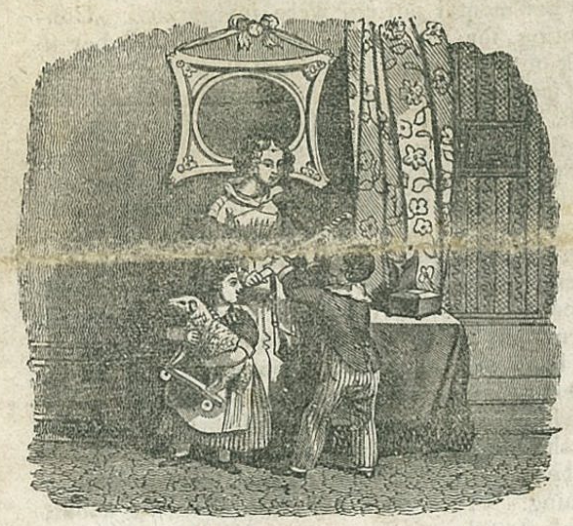
“O sister! I am sick of toys,
Although I have a plenteous hoard;
But they are only fit for boys,
Or girls like Jane:—give me the sword.
“I care not for my bat and ball,
My kite and marbles closely stored,
I will part with them one and all,
So you will give me up the sword.
“Come, hark!” the trumpet’s stirring sound
Calls every hero brave away,
To mingle on the battle ground;
You would not have me, then, delay?
“Give me the sword, and let me go,
To act the soldier’s glorious part,
To fearless meet the traitor foe,
And stab him to his coward heart.”
“Hush, Charles, you know not what you speak;
The sword—is oft a tyrant’s toy,
To crush the free, to awe the weak,
To slay, to ravage, and destroy!
“We need it not where all are free,
Where hands are strong, and hearts are bold;
Where virtue is nobility,
And honors are not bought or sold.
“Where liberty, above all price,
Is prized, and God alone adored!
Where shame awaits on gilded vice,
And—there—let go—let go the sword.”
[Child’s Annual.]
NARRATIVE.
A THRIFTY FAMILY.
“Now,” said Henry Hemphill to his young wife, when they went. to housekeeping, ‘‘it’s my business to bring money into the house, and yours to see that none goes foolishly out of it.” This was the agreement with which they set forward in the world. He chose her, first, because he loved her, and in the second place, because he knew she was sensible, economical and industrious—just the reasons which influence a sensible man in his choice now. And he thought it best that each should have a distinct sphere of action. Their interests were one and indivisible; consequently each had the same motives to act well the allotted part. His business called for his whole attention; he wished therefore to pursue it undistracted by other cares; for himself he looked for happiness only at home; there he expected a supply for all his wants, and he was of course not disposed to spend anything abroad, in pursuit of what he thought every reasonable man ought to look for in the bosom of his own family. Her duties being all domestic, she was able to compass them the better by turning her whole attention to them. Her husband’s business doing habits, his temperate and correct life, had all the power of example, increasing her esteem, and doubling her anxiety to deserve his.
They married without wanting to get rich; they neither distrusted Providence nor each other. With little besides health, and a disposition to improve it, they nevertheless had thy strong confidence of final success, which prudent resolutions inspire in those who feel they have perseverance enough to adhere to them. Thus they began the world.
To attach a man to his home it is necessary that that home should have attractions. Harry Hemphill’s had. There he sought repose after the toil and weariness of the day, and there he found it. When perplexed, and low spirited, he retired thither, amid the soothing influence of its quiet and peaceful shades; he forgot the heartlessness of the world, and all the wrongs of men. When things went ill with him, he found always a solace in the sunshine of affection, that in the domestic circle beamed upon him and dispelled every cloud from his brow. However others treated him, there all was kindness, confidence, and affection; if others deceived him, and hypocrisy, with its shameless face, smiled on him to delude and injure him, there all was sincerity—that sincerity of the heart which makes amends for suffering, and wins the troubled spirit from misanthropy.
Nothing so directly tends to make a good wife, a good housekeeper, a good domestic economist, as that kindness on the part of the husband which speaks the language of approbation, and that careful and well directed industry which thrives and gives strong promise that her care and prudence will have a favorable issue. And Mary Hemphill had this token and this assurance.
Harry devoted himself to business with steady purpose and untiring zeal; he obtained credit by his plain and honest dealing; custom by his faithful punctuality and constant care; friends by his obliging deportment and accommodating disposition. He gained the reputation of being the best workman in the village; none were ever deceived who trusted to his word. He always drove his business a little before hand, for, he said, “things go badly when the cart gets before the horse.” I noticed once a little incident which illustrated his character,—a thrifty old farmer was accosted in the road at the end of the village by a youngster, who was making a great dash in business, and who wanted to loan a few hundred dollars. The old man was perfectly ignorant where it could be had, and slided off from him as soon as he could. He rode directly down to Hemphill’s, and told him he had a few hundred dollars to loan, and wished he would take it; the payments should be easy; just as would suit. Indeed, replied Harry, you have come to a bad market; I have a little cash to spare myself, and have been looking round these two weeks for a good opportunity of putting it out.
While Harry was prospering in his business, all went like clock work at home; the family expenditures were carefully made; not a farthing was wasted, not a scrap lost; the furniture was all neat and useful, rather than ornamental; the table plain, frugal, but wholesome, and well spread; little went either to the seamstress or the tailor; no extravagance in dress, no costly company keeping, no useless waste of time in ceaseless visiting, and yet the whole neighborhood praised Mary Hemphill, and loved her; she was kind without dissipation. And while few people lived more comfortably, none lived more economically.
The results of such management can never disappoint the expectations to which it looks. Even the angry frown of misfortune is almost put at defiance. A vantage ground is soon gained which the storm seldom reaches. And the full reward comes in the proper time to crown the meed of lives thus spent.
The music of Harry’s tools was in full play on the morning that I left the village for a distant residence, It was not yet sunrise. And as the coach bore me rapidly past the cool and quick residence of the villager, I saw the door was open, and the breakfast smoking on the table. Mary in her neat morning dress and white apron, blooming in health and loveliness, was busy amid her household affairs; and a stranger who chanced to be my fellow passenger to the city, observed it, and said, ‘there is a thriving family, my word for it.” And he spoke well. There are certain signs always perceptible about those who are working things right, that cannot be mistaken by the most casual observer.
On my return to Alesbury, many years afterwards, I noticed a beautiful country residence on the banks of the river, surrounded by all the elegance of wealth and taste. Richly cultivated fields stretching themselves out on every side as far as the eye could reach; flocks and herds were scattered in every direction. It was a splendid scene—the sun was just setting behind the western hills—and while a group of neatly dressed children sported on the adjacent school house green, the mellow notes of the flute mingled with their noisy mirth, “There,” said an old friend, “lives Harry Hemphill; that is his farm—those are his cattle—here is his school house, and those are his own, and some orphan children of his adoption, which he educates at his own expense—having made a noble fortune by his industry and prudence, he spends his large income in deeds of charity, and he and Mary mutually give each other the credit of doing all this.”
My heart expanded then—it expands still when I think of them—and I pen their simple history in the hope, that as it is entirely imitable, some who read it will attempt to imitate it.
MORALITY.
THE WISE CHOICE ; OR, GREENWICH FAIR.
An interesting story, from one whose industry and integrity raised him from being a poor friendless boy, to respectability and affluence.
When I was a young man (said he) I worked five years at one place without ever asking for more than one holiday, and that one I shall have reason to remember all my days. When I applied for it, my master said to me, “Thomas, I have no objection to your having a holiday, but I should like to know how you intend to spend your time.” “Why, sir, I have heard a great deal of Greenwich Fair, and never having seen it, I intend to go there.”
“Ay, Thomas, so I thought, but it is my duty to tell you, you had better not go. In the first place you will lose half a day’s wages; in the next, you will spend, at the least, to-day’s wages more, and it is not very unlikely that you will get into bad company. What mischief bad company will do you it is impossible to say, but it often leads young men to ruin. You may run into some excess, and if you think rightly of the follies and accidents that excess brings about—sometimes ill health, and sometimes sudden death, you will be persuaded and not go.”
‘Why, sir, I mean to walk there and back again, and that will cost nothing; then I can take a bit of bread and cheese in my handkerchief, and need not spend anything; as to bad company, I think that I am proof against any temptation of THE KIND.”
“No doubt you think so, Thomas; you do not know what Greenwich Fair is. If you have made up your mind to go, we will have dinner at one o’clock, that you may be off at two; but again I tell you, you had better not go.”
“Why, sir, I have set my heart upon it, and shall think it rather hard not to go there once in my life.”
“Very well, Thomas, at two o’clock you may go.”
Exactly at one o’clock my master ordered in dinner; and no sooner did the clock strike two, than he told me I was at liberty. It took me but a short time to get ready and to set off for Greenwich, with my little stock of provisions to prevent my spending money, A great many people were going over old London bridge; for all the way to Greenwich, on a fair time, the road is like a market. At the foot of the bridge, at that time, there were some water-works, and I leaned over the bridge to look at them; but though I thought of the crowds of people at Greenwich Fair, and of the water-works that I was looking at, I thought more of what my master had said to me than all put together. When words once get a firm hold of you, it is very hard matter to get rid of them. Here had I a half day’s holiday, victuals and money in my pocket, the sun shining, and crowds of people hastening to enjoy themselves, and yet, for the life of me, I could not go on. The advice of my master was uppermost in my mind, and I thought that I should do better in attending to it, and going back to my employment, than in going forward to Greenwich Fair. I cannot say but it cost me a great deal to give up the point. I looked one way and the other way, and the scales were so nicely balanced that a feather would have turned them. When I thought of Greenwich, it seemed impossible to give up the fair; and when I thought of my master’s advice, it was impossible to go on. At last prudence won the day, and I made the best of my way back to my work,
“Why, Thomas, is it you?” said my master when he saw. me: “why, I thought you were frolicking at Greenwich; what has brought you back again?”
I told him that on stopping on London bridge to look at the water-works, I had thought over the advice he had given me, and had made up my mind to come back to my work. “You are a prudent lad, Thomas,” was the remark he made to me, and I set to work a great deal more comfortable in my mind than I had been since I first set off for Greenwich.
Nothing more was said about it during the week, but when Saturday night came, my master paid me my wages in full, and then put down a guinea by itself. “There, Thomas,” said he, “take that; you have acted prudently in following your master’s advice, and not going to Greenwich, and I trust you will not have occasion to repent it.” For aught I know, this was a turn in my life. Had I gone to Greenwich Fair, it is not unlikely that things would have happened just as my master said; and if nothing else had occurred, perhaps, it would have been the beginning. of bad habits, which might have clung to me all my days; whereas, by taking good counsel, I had got a golden guinea, the good opinion of my master, and the consciousness of having acted properly.
[Youth’s Friend.]
THE NURSERY.
Written for the Youth’s Companion.
DO THYSELF NO HARM.
Mother. Take care, my daughter, do not talk so much at random; you not only do harm to others, but you do great harm to yourself,
Juliana. Do harm to myself, mother! I hope not, for I care too much about myself for that,
M. Yes; but you may do a great deal of harm, to yourself for all that. Every one cares about themselves, yet the world is full of people that harm themselves, Do you not remember the exhortation of the Apostle, ‘‘ Do thyself no harm.” The Apostle knew, full well, that people were continually harming themselves. If no one did themselves any harm, we should soon see a different state of things, all over the world. The millenium would soon come. The Sun of Righteousness would arise, and shed his healing beams over the nations.
Whenever we do harm to others, we do harm to ourselves. God has mercifully, and kindly, connected our duty and our interest. If we do harm to others, we do harm to ourselves. If we do good to others, we do good to ourselves. Do not the drunkards, the liars, the Sabbath breakers do harm to themselves; and by their influence and example, do they not do harm to others? Do not the [unk], the busy bodies, the tale bearers do harm to themselves; and do they not harm others? Do not the lazy, the idle, the disobedient children harm themselves; and do they not harm others?
J. But, mother, do tell me all the different ways in which I harm myself; for I want to leave them
M. Ah, my daughter, there is too much depravity in your heart, you love to do wrong too well, or you would have left them off long ago. Holy beings never harm themselves. All harm is the effect of sin. Every time you sin, you harm yourself; and so long as you do not love and obey Christ, you sin all the time, and, of course, harm yourself all the time.
Did you not harm yourself when you neglected your lesson the other day. You lost the privilege of becoming acquainted with that part of your philosophy; you could not see the interesting experiments that were exhibited on that day; you sunk yourself in the estimation of the class, and failed of getting the approbation of your teacher and your parents.
Did you not harm yourself when you walked out in the wet, with thin shoes? You. took cold, could not attend meeting the next Sabbath, could not attend the Juvenile Society on Monday; and by doing that which injured your health, were guilty of breaking the sixth commandment. Did you not harm yourself this morning by neglecting your regular work ?
J. I do not see how I harmed myself then. Nelly did the work for me, and so I think I rather harmed her, than myself.
M. It is true you did harm to Nelly, for she had enough to do without doing your work. But you did much more harm to yourself than to her. By neglecting your duty, you were guilty of the sins of disobedience and laziness. It tended, also, to the formation of a bad habit, and, if you would be honest with yourself, you would acknowledge that by doing your duty you would have been far happier, than by neglecting it. Your health suffered for want of exercise; your conscience was continually reproaching you, and you knew that we all disapproved of your conduct.
J. That is all true, I know, mother, for I felt that IT had done wrong; it made me very unhappy to see that you were displeased with me, and for the want.of exorsise, I felt dull all day.
M. Yes; and whenever you neglect any duty, or do anything that you ought not, you do yourself harm. You suffer from the disapprobation of your friends, from the reproofs of conscience; and O! there is a more fearful suffering to which you are liable. You know that God sees you, that all your bad actions are recorded in the book of his remembrance; and you think of that day, and it will surely come, when you must render up your account to him.
When you spend your money in buying candy, sugar-plums, etc. you do yourself harm, You injure your health, acquire the habit of indulging in sensual gratification, and deprive yourself the pleasure of doing good with your money. A little girl, who formerly attended my school, was in the constant habit of spending all the money she could get at the confectioners. I told her how unwise she was, to do so, how she injured her health, injured her mental powers, and deprived herself of the pleasure of doing good with her money. Finally, she was induced to give away a part of her money; and she found so much pleasure in it, that she gave away more, and, at last, she gave away nearly all the money she had the disposal of. And, really, it was delightful to see how her health improved, how much more cheerful she was, and how her mental powers were invigorated. Contributing for the good of souls, induced her to think of the value of her own soul, and seemed to be a means of leading her to a knowledge of the truth. Now you can see how much harm this little girl must have done herself, had she continued thus to waste her money.
Suppose two little girls grow up together. One spends her Sabbaths in the best manner. Her time, at home, she employs in religious reading, meditation, and prayer. While at the Sabbath School she vigorously applies her mind to receive instruction, and in church, she endeavors to worship God with undivided attention. Her mental powers are enlarged, her mind is enriched with a knowledge of divine truth, her heart is affected, and she becomes a Christian.
The other little girl sleeps very late on Sabbath morning. While at home, she saunters about, looks out at the windows, etc. While at the Sabbath School, she is very inattentive. Her teacher talks to her, but she is all the time thinking about something else, perhaps looking at some other scholar. While in church, she sleeps some of the time, and some of the time her mind is on trifles. She gets no good. She does not like her Sabbath School teacher, does not like her minister, and her heart becomes harder and harder. Her friends begin to fear she will never embrace religion. She lives a few years, and dies without giving any evidence of being prepared. Did not this little girl do herself harm? O yes, she did harm to her intellectual powers, she did harm to her reputation, she did harm to her undying soul.
R. E.
BENEVOLENCE.
Written for the Youth’s Companion.
A LEAF FROM A MISSIONARY JOURNAL.
The last Sabbath I spent in Mass. I visited the Infant Sabbath School of ——. It was an interesting group of about forty five children of both sexes, between the ages of three and eight years. The children all knew me, for I had twice during the summer visited the same school, and related to them some simple facts respecting the Indian children, where I had for many years been living and laboring; to which they listened with deep and interested attention. After answering a number of questions which were put to them from the question book compiled by their teacher for the use of Infant Sabbath Schools, their teacher told them that she would not ask them any more questions then, for Mr. —— had come in to see them again, and she wanted to give him an opportunity to talk to them a few minutes, and she wished to have them pay particular attention to what he said; for it was probably the last time he would ever talk to them, for in a few days he expected to leave and go far away to the heathen. “Now,” said their teacher, “put up your hands and sit still and listen.” In a moment every hand was in its place, every eye fixed, and every ear opened to receive instruction. There was silence, such silence as I never witnessed among so many little children; while joy beamed in every countenance, while I spoke to them. It was truly an interesting and solemn time. I never addressed a more interesting and attentive audience. I never expected to meet them, or see them again, until I met them in Eternity. After speaking a few minutes in a plain and solemn manner, entreating them to attend to what their pious teacher told them; telling them how much greater their privileges were than that of the poor heathen children who had no Sabbath Schools, and none to teach them to read, or tell them of the Saviour, and point them to the “Lamb of God who taketh away the sins of the world,” I commended them in prayer to the Good Shepherd who has said, “he will gather the lambs in his arms and carry them in his bosom.” On the morning previous to my departure, a little girl came running to me in the street, all animation, while her countenance indicated deep anxiety. I did not know her, but on inquiry found that she was one of the Infant Sabbath School scholars whom I had repeatedly addressed. With much sincerity and childlike simplicity, which touched a tender chord in my heart and awakened all the lively sensibilities of my soul, she addressed me in the following manner.
Child. Mr. ——, when are you going to Boston? (supposing I had to go that way on my journey home.)
Myself. I shall not go to B, but shall start on my long journey home, this afternoon.
C. Shan’t I see you any more?
M. It is not probable that you will. Do you know me?
C. Yes, sir.
M. Where did you see me?
C. In the Sabbath School.
M. What did I say?
C. You told us about the little Indian children, and the Saviour.
M. Shall you forget what I said?
C. No, sir.
M. Shall you forget the Missionary?
C. No, sir.
M. Will you be a good girl, and love the Saviour, and when you are old enough go and teach the heathen children?
C. Yes, Sir.
This was said with much apparent sincerity and thoughtfulness.
Having but little time, I gave the little girl a kiss, and we parted, to meet no more until the trump of God shall sound, and awake the sleeping dead. But this interview made a deep impression on my mind. As I walked along, my thoughts dwelt not only upon what had just past, but upon that Infant school and the last visit I made to that school. I could but hope, and pray, and almost believe, that I had been addressing some young Harriet Newells or Henry Martyns, and when a few more years had brought to maturity, and divine grace had renewed the heart, would be willing to forsake father and mother, brothers and sisters, houses and lands, and go far away to the heathen to tell them the story of Jesus, and make known to them the way of salvation through a crucified Redeemer. Several months have passed away since I visited that school; but the impression is fresh on my mind. In imagination I often visit it, for my thoughts love to dwell on the scene. I love to think of that little girl, and pray for her; and for those other little children, many of whom I hope to meet in heaven. That the good Shepherd would gather them in his arm, carry them in his bosom, sanctify them by his Spirit, prepare them for usefulness here and happiness hereafter, is the prayer of their sincere friend,
H.
OBITUARY.
From the Watchtower.
ELIZABETH TENNEY.
Died at Ipswich, May 23, 1838, ELIZABETH TENNEY, daughter of Mr, Jacob and Mrs. Caroline Tenney, in the tenth year of her age.
She was a very sensible and interesting child. To her parents she was much endeared, as a very affectionate and dutiful daughter; and by all who knew her she was esteemed as an amiable girl.
She also gave decisive evidence of piety. At times she appeared very serious from six years old and upward. This seriousness arose in some degree from the conversation of a pious relative, Miss Charlotte Cram, sister of her mother, who resided in the family, and who died in the Lord, Dec. 1836. Soon after the death of Miss Cram, Mrs. Tenney was converted, and made a profession of religion in July, 1837. The serious impressions on the mind of Elizabeth were deepened by the faithful instructions and the Christian example of her mother, after her conversion. The conversation of her Sabbath School teachers contributed much to her spiritual good. In strong language she testified to the fidelity of her teachers. The following is an instance: ‘‘O mother,” said she, “Miss V. was a faithful teacher. She prays for us at home. I know she does. When she was conversing with another scholar, and saw me grieving, she took me aside, and conversed with me, and told me, she would pray for me, and that I must pray for myself, before I went to bed.”
Elizabeth was very serious all last winter. The pastor called to see her one evening in March; several little girls of her acquaintance came in, while he was there. During prayers her mother perceived her to be in tears. Soon after she asked her, why she cried, adding, “Don’t you love the Saviour?” she said, “I fear I do not.” Her pastor in his visits, which she wished him to repeat daily, held several conversations with her on love to Christ. On one occasion she asked him how she should know, whether she loved him or not. He told her, if she loved him, she would keep his commandments; and his commandments would not be grievous to her, she would take pleasure in obeying him. On his next visit he asked her how she had been, since he saw her. She replied, “very happy. I have felt much love in my heart toward Christ,” adding, “he appears very near to me.” She highly enjoyed a short conversation with him on the subject of seeing Christ as he is after death. As her sickness and suffering increased, she evidently became more established in her love to Christ, and more and more happy in his love.
She was patient and resigned during her whole sickness, never uttering a complaint, but always speaking in a very pleasant voice.
She was much in prayer. She prayed for others, no less than for herself, She expressed a strong desire, that all her relatives and friends might have religion, and be prepared for heaven. Among those for whom she expressed this desire with the greatest frequency and strength were her father, her little and only sister, several girls of her particular acquaintance, and her classmates in the Sabbath School. Once when her pastor asked her, what he should pray for, her father being present, she beckoning to him to come near to her, said in a suppressed but sweet voice, ‘‘my father, pray for my father.”
When her mother asked her, if she should live to get well how she would conduct toward her playmates, she said, “instead of spending my time in play, I would take them aside, and pray with them.”
The conversion of her father, who, though a very amiable man, kind to his family, and correct in his morals, has been inconstant in his attendance on public worship, lay very near her heart. In conversing with her mother a few weeks before her death, she said, “O, mother, I should be willing to die, if my death might be the means of my father’s conversion.” When her mother desired her to converse with him, she hesitated for a time. Not long after she was overheard praying, that she might have strength to converse with him, which she did on the last Sabbath of her life. She said to him, that she was going to leave him, and entreated him to pray and seek religion, and he promised her he would. At the same time she said to her sister Sarah, who was between six and seven years old, “ain’t you willing that I should die?” Sarah said, “No.” She replied, “If it is God’s will, and if I am willing to die, sure you ought to be willing I should.”
On the next Tuesday she conversed again with her father. She gave him her Testament, saying, “I want you to read it, will you read it, Father?” He said, “yes dear, I will.” She entreated him to go to meeting, to seek religion, and prepare to die. She said to him, “If you pray in sincerity, you will find religion.” Perceiving him to be in tears, she said, “don’t cry, because I am going to leave you. The separation will be only for a short time, if you seek religion. I love you dearly; but I love my Heavenly Father more. I am willing to leave father and mother, for the sake of being with Christ, and seeing him as he is.” When her mother wept, Elizabeth looked as though she thought it wrong. Her mother said, “I can weep for you without sinning, for at the grave of Lazarus, Jesus wept.” Elizabeth was satisfied, and said, “O yes.”
A week before she died, she desired her sister to get into her bed, for she wanted to talk with her, “Dear sister,” said she, “how I love you. I am going to die and leave you. I want you to pray. I want you to be a Christian, to have a new heart. I want you to pray now.’’ Sarah thought she could not. She however prevailed upon her to say, “Our Father, who art in heaven,” and “Now I lay me down to sleep.” And told her, “These are good prayers. They are excellent. But, she added, you have always been in the habit of saying them, and you don’t feel them. Say some of your own words. For you know the hymn says, God does not care for what we say, unless we feel it too.” She then told her, she must not go to bed that night, without kneeling down and praying.
She requested her mother to visit her grave every Saturday evening, and take Sarah with her, and try to impress upon her mind that she must die, and to do every thing in her power to make her a Christian, and to tell all her little cousins that they are not too young to die.
When any persons came into her chamber, she asked her mother if they were Christians, and if told that they were, she requested them to pray with her.
Elizabeth was very happy in her sickness, Her mother asked her one night, if she was willing to die? O yes, she said, willing to die or willing to live. At her request, says one who was with her a considerable part of several of the last days of her life, I read her some hymns, and some psalms from the Bible. She said they were precious, and suited her case exactly. She attempted to repeat, “Jesus can make a dying bed, feel soft as downy pillows are.” She added, “it seems to me impossible, that I should live through the day. I do not wish it. I want to die. Can’t you pray, that I may die? O come, Lord Jesus, come quickly.” To a teacher of young children she remarked sometime before, that if God permitted her to live, she would try to do good. The teacher observed, perhaps God knows, that you would do more good by your death, than you could by your life. “Does he, said she? then I am willing to die. Dear Miss D. don’t cry, because I am going to die and leave you, Tell all the scholars, they must have new hearts, and love the Saviour. Tell them, I want them to be as happy, as I am.”
That all who read this narrative may be as pious and as happy in their last hours, as Elizabeth Tenney was, is the ardent desire of one who loves the souls of the young,
D.T.K.
RELIGION.
THE WOUNDED SOLDIER.
There was a boy who had been brought up in a Sunday School, where it was customary, that the children should repeat, every succeeding Sunday, the appropriate collect of the day. He afterward entered upon the world, left a pious mother and became a soldier, but I lament to say, that in the army he lost almost every trace of his religion; and the experience he had acquired in younger years was effaced by the habits of military life. It so happened that he was engaged in one of those great battles which occurred so frequently during the last war, and he received a wound which left him upon the ground in a state that seemed to be hopeless. Feeling, as he did, that he was on the very confines of the eternal world, all the recollections of his past life rushed upon his memory: the habits that he had acquired in his military engagements, and all the principles of his youth that he had lost, presented themselves most powerfully to his mind; and, from his own account, he endeavored to lift up his heart in prayer; but he had lived without prayer; he did not know how to pray, and no words whatever suggested themselves to his mind. Still, in the midst of that awful feeling with which his mind was possessed, he struggled to give utterance to his thoughts in the language of prayer, addressing the God whom he had offended, and the Saviour whose cause he had deserted: at length, a collect that he had learnt as a boy at school, presented itself to his memory. It was the language of prayer—it was a supplication for pardon—it recognized the Saviour as the ground of his hope—it was offered up in the spirit of penitence and true contrition; and from that time he felt as if a burden had been removed, and he had found access to the throne of grace. It pleased God to spare his life; he returned to his own country; and feeling how much he was indebted to what he had learnt in the days of his childhood at the Sunday School he made a resolution to save the sum of one guinea, and at the very first sermon that he might hear preached for a Sunday School, to drop the sum into the plate. He did so. The town where the sermon was preached was Leeds. When he dropped the guinea into the plate, the person who held it, supposing he had made a mistake, and had contributed a guinea instead of a shilling, brought it back again, and explained the mistake which he presumed he had made; but he said, “Sir, it is not a mistake; the sum that I have laid down has been collected during many, weeks, and I wish it to be an offering of gratitude to my God.” Being requested to explain what the circumstance might be which led to so liberal an act, he retired into the vestry, and there related the facts which I have had the pleasure of now communicating to my little readers.
[London Teacher’s Offering.]
EDITORIAL.
THE WOOD-VINE.
Close at the side of a tall oak, grew a little wild wood-vine, with a delicate blossom. Its infant eye had seldom seen the sun, the glory of the beautiful sky, for the green branches above it formed a covering through which the sky could scarcely be seen. But as the flower had never seen the heavens, it knew not of what it was deprived, and contentedly and affectionately its tendrils clung to the trunk of the powerful oak.
At length one came, and told her of the broad blue sky; of the sum and the stars, and bade her look—no longer content herself with gazing upon the leafy sky above her, but submit to be transplanted to another spot, where nothing could come between her and heaven. But the flower replied, “I am satisfied with the green sky which nature has provided for me. It was the first object which met my eye, it is the only thing I have to love, and I would not for worlds change my place. Besides, the sunlight does sometimes steal through the green leaves and plays among the shadows on the grass at my feet, and I have seen, here and there among the openings, a tiny spot of blue; with this I am satisfied.”
“But,” Said the other, “you are a low and insignificant plant, your blossoms unfold slowly, and their hue is dull and faint when compared with that of other flowers. It is.because the heavens look not kindly upon them.”
“Then,” said the wild wood-vine, “I will ask yonder patch of sky, and that faint ray of sunshine which comes stealing through the branches, to give my blossoms a brighter hue.” And thus she prayed; but the blue sky heard her not, and the sunny ray danced away, and she saw it no more.
Then the other smiled, and said, “If it were not for the bounty of heaven you would not be in existence. Pray from whence comes the gentle dew that nightly moistens your purple bells, and the soft shower that steals down through the dark earth to your roots? What indeed grants to you this beautiful tree, but the heavens you love so little?”
The little vine listened, and her heart whispered, though her lips did not move. “Truly, a pretty piece of news! Have I not seen with my own eyes, the bright rain drops shower down upon me from the leaves of my own dear tree?” And she clung even more closely to the idol of her heart, from which she believed, came every good gift.
Many days passed, and then there came a rushing wind through the still forest. The branches of many trees were broken, but the oak stood unharmed amid it all. Then the little vine rejoiced. But after the wind had died away, there came a fiercer storm of rain. The vine heard the loud thunder as it rolled above her head, and dared not raise her eyes from the earth. Then there came a flash of fire from heaven; the flames embraced the branches of the oak and seemed dancing from limb to limb. The vine looked up and smiled at the brightness; but when it had gone, the proud oak was dead. Its green leaves were shrivelled and brown; its branches were broken off, and lay black and burned upon the ground. A tear dimmed the eye of the flower in the early morning as she looked upon the fearful sight around her. The sun came triumphantly forth and shone for the first time brightly upon her head. Timidly she looked up, and there were the broad blue heavens stretched in all their glory above her, and the sun shedding his rays over the whole sky. The tear of the flower had dried, as she gazed stedfastly upon the glories of the new world. And many days her eyes were raised to heaven, and while she looked, a newer strength and beauty stole through her frame. Her green leaves opened boldly out in the sunshine, a deeper color flushed her delicate blossoms, and she rose upward in loveliness, yet unconscious of the change. When she thought of the idol to which she had clung, how in her affection for it she had refused to see aught beside, she sighed, yet still gazed upon the sky.
My little reader, must God take away the object that comes between your heart and heaven, before you look upon its glory?
VARIETY.
From the Western Christian Advocate.
The Bee and the Butterfly.
Written by a little girl nine years of age.
The bee and the butterfly are both very interesting insects, yet we find in them a very great difference. The bee is very industrious; it is out very early in the morning seeking honey from the sweet flowers, and continues to work hard all day. It fills the cells in the hives with honey for the winter, so that they and the young ones may be comfortable, and have enough to eat in the cold weather, when they cannot work. It is instinct that teaches the bee to do this; all insects are taught by instinct, which God gives them, that they may know hew to take care of themselves and their young.
The butterfly has instinct. It lays its eggs on the cabbage leaf, which furnishes food for the young catterpillars, when they are hatched out. This worm is then changed into a chrysalis. The chrysalis then attaches itself to the wall or window by a silken button for several weeks. It then bursts its shell, and comes out a gay, beautiful butterfly, and flies about in the sunshine for several days or weeks, sipping honey from every flower, and then dies.
In books, we have many interesting accounts of the bee and butterfly. From the bee we have a lesson of industry, and we ought to intimate its example.
Some children are like the bee. They are very studious when they go to school, and try to improve their minds; so that they can work when they grow up, and lay up something to live upon when they grow to be old. I hope I shall imitate the bee; and not like the butterfly, fly about and glitter for a little while, and then die and be forgotten.
GLORIANNA H. KILLBOURNE
Praying with the Heart.
A little girl once asked me how she could pray with her heart, as one had told her she must. i will tell her how, but I must ask her one question, too. What are some of the things you pray for? You often say, “Give us our daily bread.” Now suppose you had just returned from school, very hungry, what would you do? You would go at once to your mother, and ask her for bread. You would ask earnestly, and you would ask, believing that she would give it to you, because she had done so often before. In the same way you should ask your heavenly Parent, not only for food; but for protection and life.
You often say, “Forgive us our sins.” Suppose, again, that you had offended your mother; your heart would be very heavy; you would have no peace. If at study, you would think of your kind mother’s just displeasure; if at play, you would stop and remember that no sweet smile would meet you when you went home. Would you, then, expect her to pardon you, if you went to her and said carelessly, “Mother, forgive me?” No, you could not; but you would go with tears in your eyes, and entreat her to forgive you; you would remind her, that she had always been kind to you, and you would promise to be better in future, and you would not be happy until you were sure she was satisfied with you. This would all come from your heart. Now, my dear child, think of this next time you kneel down to pray, and ask God for ”daily bread,” with as much confidence that he will hear you as you have when you ask your mother. And pray him to forgive your sins with the same feelings that you ask your mother’s pardon.
[London Teacher’s Offering.]
Reasoning of a Child.
A child six years old, hearing her father speaking of still slop milk, inquired, “Father is still slop poison?” ”Why, what makes you think it poison?” said her father. “O, I thought perhaps there might be spirits in it. I wish there were no spirits, father?” “Why, my dear, do you wish there were no spirits?” “Because then there would not be so many poor people and poor children; and there wouldn’t be so many drunkards?” “How did you know any thing about drunkards, my dear? did you ever see one?” “I saw the body of one, lying down on the commons.” “Well said, my child; I don’t wonder you say you saw the body of one; for truly, you could not tell whether there was any soul there or not.” “Father,” said she, “If I reigned over Massachusetts, I wouldn’t have any spirits in this city, nor in all Massachusetts—I’d turn it all out.”
God who feeds the ravens, will not starve his doves.
POETRY.
A CHILD’S GARDEN.
Full of flowers as it could be, And London pride its border.
And soon as came the pleasant Spring,
The singing birds built in it,
The blackbird and the throstle-cock,
The woodlark and the linnet.
A lilac tree and a guelder-rose,
A broom and a tiger-lily,
And I walked a dozen miles to find
The true white daffodilly.
I had marigolds and gilliflowers,
And pinks, all pinks exceeding,
I’d a noble root of love-in-a-mist,
And plenty of love-lies-bleeding.
I found far off in the pleasant fields
More flowers than I can mention;
I found the English asphodel
And the Spring and Autumn gentian.
I found the orchis, fly and bee,
And the cistus of the mountain,
And money-wort and the adder’s tongue,
Beside an old wood fountain.
I found, within another wood,
The rare pyrola blowing;
For where’er there was a pleasant flower,
I was sure to find it growing.
I set them in my garden beds,
Those beds I loved so dearly,—
Where I labored at set of sun,
And in summer mornings early.
O my pleasant, pleasant garden-plot!
A shrubbery was beside it,—
And an old and mossy apple tree,
With a woodbine wreathed around it.
[Mary Hewitt.]